 Add to Chrome
 Add to Firefox
 Add to Edge
TGFormer: Towards Temporal Graph Transformer with Auto-Correlation Mechanism
May 24, 2026
The growing interest in Temporal Graph Neural Networks (TGNNs) stems from their ability to model complex dynamics and deliver superior performance. However, TGNNs encounter fundamental challenges in capturing long-term dependencies and identifying periodic patterns. To address these limitations, we propose TGFormer, a novel Transformer architecture specifically designed for temporal graphs. Our model redefines temporal graph learning by establishing a trajectory framework that aligns with time series analysis principles. This approach allows TGFormer to derive node representations through systematic analysis of historical interactions, enabling granular examination of node relationships across sequential timestamps. Building upon stochastic process theory, we develop an auto-correlation mechanism that systematically uncovers periodic dependencies in node interactions. This innovation empowers TGFormer to perform dependency discovery and representation aggregation at sub-interaction levels, demonstrating superior efficiency and accuracy compared to conventional attention mechanisms. Experimental validation across six public benchmarks confirms the effectiveness of our approach, with TGFormer at most achieving 9.35\% precision improvement compared to state-of-the-art approaches.

JT-SAFE-V2: Safety-by-Design Foundation Model with World-Context Data
May 23, 2026We introduce JT-Safe-V2, a large language model designed to advance the safety and trustworthiness of foundation models, extending our previous JT-Safe model toward a more comprehensive safety-by-design paradigm. JT-Safe-V2 emphasizes the joint optimization of general intelligence and safety-by-design through several key innovations: enriching pre-training data with contextual world knowledge, high-certainty pre-training procedures, and safety strengthening post-training mechanisms for enterprise-oriented agentic capabilities. Building on these safety-enhanced foundation models, we propose Safe-MoMA (Safe Mixture of Models and Agents), a framework that enables traceable and efficient inference through the orchestrated deployment of multiple models and agents. Extensive evaluations demonstrate that JT-Safe-V2 achieves state-of-the-art performance across both general intelligence and safety benchmarks. Moreover, Safe-MoMA reduces inference costs by more than 30\% compared to using the largest standalone model baseline while maintaining comparable performance. To facilitate future research on safety-by-design foundation models, we publicly release the post-trained JT-Safe-V2-35B model checkpoint.
Unified Multi-Domain Graph Pre-training for Homogeneous and Heterogeneous Graphs via Domain-Specific Expert Encoding
Feb 13, 2026Graph pre-training has achieved remarkable success in recent years, delivering transferable representations for downstream adaptation. However, most existing methods are designed for either homogeneous or heterogeneous graphs, thereby hindering unified graph modeling across diverse graph types. This separation contradicts real-world applications, where mixed homogeneous and heterogeneous graphs are ubiquitous, and distribution shifts between upstream pre-training and downstream deployment are common. In this paper, we empirically demonstrate that a balanced mixture of homogeneous and heterogeneous graph pre-training benefits downstream tasks and propose a unified multi-domain \textbf{G}raph \textbf{P}re-training method across \textbf{H}omogeneous and \textbf{H}eterogeneous graphs ($\mathbf{GPH^{2}}$). To address the lack of a unified encoder for homogeneous and heterogeneous graphs, we propose a Unified Multi-View Graph Construction that simultaneously encodes both without explicit graph-type-specific designs. To cope with the increased cross-domain distribution discrepancies arising from mixed graphs, we introduce domain-specific expert encoding. Each expert is independently pre-trained on a single graph to capture domain-specific knowledge, thereby shielding the pre-training encoder from the adverse effects of cross-domain discrepancies. For downstream tasks, we further design a Task-oriented Expert Fusion Strategy that adaptively integrates multiple experts based on their discriminative strengths. Extensive experiments on mixed graphs demonstrate that $\text{GPH}^{2}$ enables stable transfer across graph types and domains, significantly outperforming existing graph pre-training methods.
GP2F: Cross-Domain Graph Prompting with Adaptive Fusion of Pre-trained Graph Neural Networks
Feb 12, 2026Graph Prompt Learning (GPL) has recently emerged as a promising paradigm for downstream adaptation of pre-trained graph models, mitigating the misalignment between pre-training objectives and downstream tasks. Recently, the focus of GPL has shifted from in-domain to cross-domain scenarios, which is closer to the real world applications, where the pre-training source and downstream target often differ substantially in data distribution. However, why GPLs remain effective under such domain shifts is still unexplored. Empirically, we observe that representative GPL methods are competitive with two simple baselines in cross-domain settings: full fine-tuning (FT) and linear probing (LP), motivating us to explore a deeper understanding of the prompting mechanism. We provide a theoretical analysis demonstrating that jointly leveraging these two complementary branches yields a smaller estimation error than using either branch alone, formally proving that cross-domain GPL benefits from the integration between pre-trained knowledge and task-specific adaptation. Based on this insight, we propose GP2F, a dual-branch GPL method that explicitly instantiates the two extremes: (1) a frozen branch that retains pre-trained knowledge, and (2) an adapted branch with lightweight adapters for task-specific adaptation. We then perform adaptive fusion under topology constraints via a contrastive loss and a topology-consistent loss. Extensive experiments on cross-domain few-shot node and graph classification demonstrate that our method outperforms existing methods.
AceGRPO: Adaptive Curriculum Enhanced Group Relative Policy Optimization for Autonomous Machine Learning Engineering
Feb 08, 2026Autonomous Machine Learning Engineering (MLE) requires agents to perform sustained, iterative optimization over long horizons. While recent LLM-based agents show promise, current prompt-based agents for MLE suffer from behavioral stagnation due to frozen parameters. Although Reinforcement Learning (RL) offers a remedy, applying it to MLE is hindered by prohibitive execution latency and inefficient data selection. Recognizing these challenges, we propose AceGRPO with two core components: (1) Evolving Data Buffer that continuously repurposes execution traces into reusable training tasks, and (2) Adaptive Sampling guided by a Learnability Potential function, which dynamically prioritizes tasks at the agent's learning frontier to maximize learning efficiency. Leveraging AceGRPO, our trained Ace-30B model achieves a 100% valid submission rate on MLE-Bench-Lite, approaches the performance of proprietary frontier models, and outperforms larger open-source baselines (e.g., DeepSeek-V3.2), demonstrating robust capability for sustained iterative optimization. Code is available at https://github.com/yuzhu-cai/AceGRPO.
From Self-Evolving Synthetic Data to Verifiable-Reward RL: Post-Training Multi-turn Interactive Tool-Using Agents
Jan 30, 2026Interactive tool-using agents must solve real-world tasks via multi-turn interaction with both humans and external environments, requiring dialogue state tracking, multi-step tool execution, while following complex instructions. Post-training such agents is challenging because synthesis for high-quality multi-turn tool-use data is difficult to scale, and reinforcement learning (RL) could face noisy signals caused by user simulation, leading to degraded training efficiency. We propose a unified framework that combines a self-evolving data agent with verifier-based RL. Our system, EigenData, is a hierarchical multi-agent engine that synthesizes tool-grounded dialogues together with executable per-instance checkers, and improves generation reliability via closed-loop self-evolving process that updates prompts and workflow. Building on the synthetic data, we develop an RL recipe that first fine-tunes the user model and then applies GRPO-style training with trajectory-level group-relative advantages and dynamic filtering, yielding consistent improvements beyond SFT. Evaluated on tau^2-bench, our best model reaches 73.0% pass^1 on Airline and 98.3% pass^1 on Telecom, matching or exceeding frontier models. Overall, our results suggest a scalable pathway for bootstrapping complex tool-using behaviors without expensive human annotation.
Toward Ultra-Long-Horizon Agentic Science: Cognitive Accumulation for Machine Learning Engineering
Jan 15, 2026The advancement of artificial intelligence toward agentic science is currently bottlenecked by the challenge of ultra-long-horizon autonomy, the ability to sustain strategic coherence and iterative correction over experimental cycles spanning days or weeks. While Large Language Models (LLMs) have demonstrated prowess in short-horizon reasoning, they are easily overwhelmed by execution details in the high-dimensional, delayed-feedback environments of real-world research, failing to consolidate sparse feedback into coherent long-term guidance. Here, we present ML-Master 2.0, an autonomous agent that masters ultra-long-horizon machine learning engineering (MLE) which is a representative microcosm of scientific discovery. By reframing context management as a process of cognitive accumulation, our approach introduces Hierarchical Cognitive Caching (HCC), a multi-tiered architecture inspired by computer systems that enables the structural differentiation of experience over time. By dynamically distilling transient execution traces into stable knowledge and cross-task wisdom, HCC allows agents to decouple immediate execution from long-term experimental strategy, effectively overcoming the scaling limits of static context windows. In evaluations on OpenAI's MLE-Bench under 24-hour budgets, ML-Master 2.0 achieves a state-of-the-art medal rate of 56.44%. Our findings demonstrate that ultra-long-horizon autonomy provides a scalable blueprint for AI capable of autonomous exploration beyond human-precedent complexities.
The Llama 4 Herd: Architecture, Training, Evaluation, and Deployment Notes
Jan 15, 2026This document consolidates publicly reported technical details about Metas Llama 4 model family. It summarizes (i) released variants (Scout and Maverick) and the broader herd context including the previewed Behemoth teacher model, (ii) architectural characteristics beyond a high-level MoE description covering routed/shared-expert structure, early-fusion multimodality, and long-context design elements reported for Scout (iRoPE and length generalization strategies), (iii) training disclosures spanning pre-training, mid-training for long-context extension, and post-training methodology (lightweight SFT, online RL, and lightweight DPO) as described in release materials, (iv) developer-reported benchmark results for both base and instruction-tuned checkpoints, and (v) practical deployment constraints observed across major serving environments, including provider-specific context limits and quantization packaging. The manuscript also summarizes licensing obligations relevant to redistribution and derivative naming, and reviews publicly described safeguards and evaluation practices. The goal is to provide a compact technical reference for researchers and practitioners who need precise, source-backed facts about Llama 4.
One Prompt Fits All: Universal Graph Adaptation for Pretrained Models
Sep 26, 2025Graph Prompt Learning (GPL) has emerged as a promising paradigm that bridges graph pretraining models and downstream scenarios, mitigating label dependency and the misalignment between upstream pretraining and downstream tasks. Although existing GPL studies explore various prompt strategies, their effectiveness and underlying principles remain unclear. We identify two critical limitations: (1) Lack of consensus on underlying mechanisms: Despite current GPLs have advanced the field, there is no consensus on how prompts interact with pretrained models, as different strategies intervene at varying spaces within the model, i.e., input-level, layer-wise, and representation-level prompts. (2) Limited scenario adaptability: Most methods fail to generalize across diverse downstream scenarios, especially under data distribution shifts (e.g., homophilic-to-heterophilic graphs). To address these issues, we theoretically analyze existing GPL approaches and reveal that representation-level prompts essentially function as fine-tuning a simple downstream classifier, proposing that graph prompt learning should focus on unleashing the capability of pretrained models, and the classifier adapts to downstream scenarios. Based on our findings, we propose UniPrompt, a novel GPL method that adapts any pretrained models, unleashing the capability of pretrained models while preserving the structure of the input graph. Extensive experiments demonstrate that our method can effectively integrate with various pretrained models and achieve strong performance across in-domain and cross-domain scenarios.
HGMP:Heterogeneous Graph Multi-Task Prompt Learning
Jul 10, 2025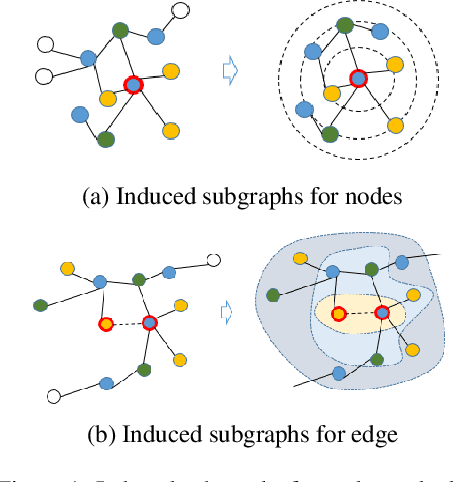
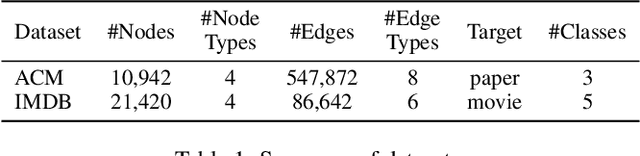
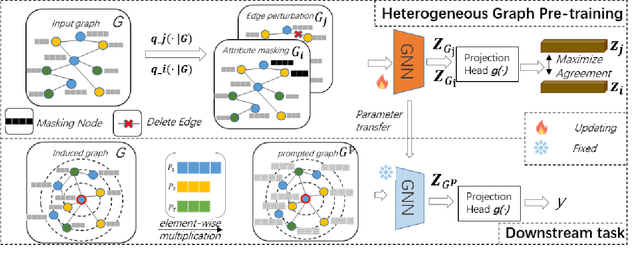
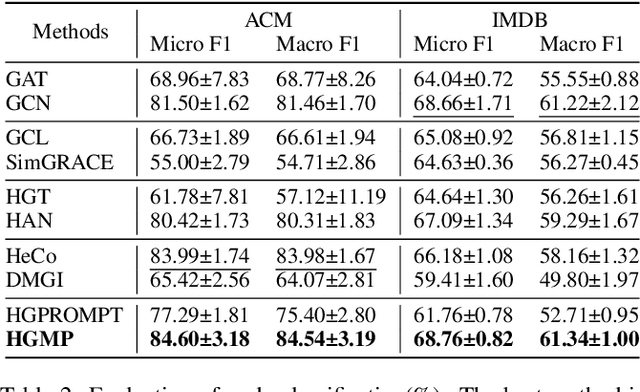
The pre-training and fine-tuning methods have gained widespread attention in the field of heterogeneous graph neural networks due to their ability to leverage large amounts of unlabeled data during the pre-training phase, allowing the model to learn rich structural features. However, these methods face the issue of a mismatch between the pre-trained model and downstream tasks, leading to suboptimal performance in certain application scenarios. Prompt learning methods have emerged as a new direction in heterogeneous graph tasks, as they allow flexible adaptation of task representations to address target inconsistency. Building on this idea, this paper proposes a novel multi-task prompt framework for the heterogeneous graph domain, named HGMP. First, to bridge the gap between the pre-trained model and downstream tasks, we reformulate all downstream tasks into a unified graph-level task format. Next, we address the limitations of existing graph prompt learning methods, which struggle to integrate contrastive pre-training strategies in the heterogeneous graph domain. We design a graph-level contrastive pre-training strategy to better leverage heterogeneous information and enhance performance in multi-task scenarios. Finally, we introduce heterogeneous feature prompts, which enhance model performance by refining the representation of input graph features. Experimental results on public datasets show that our proposed method adapts well to various tasks and significantly outperforms baseline methods.